Some have claimed our housing market is “collapsing.” The facts tell a very different story. Charleston Trident Association of REALTORS reports from 2019 through 2025 indicate that, although the pace of sales has cooled since the pandemic boom, home values remain near record highs, and the fundamentals remain strong. Folly’s lasting value comes from more than property prices; it comes from the unique community we protect.
*You can access the reports used to create this analysis here
Real Estate Bottom Line
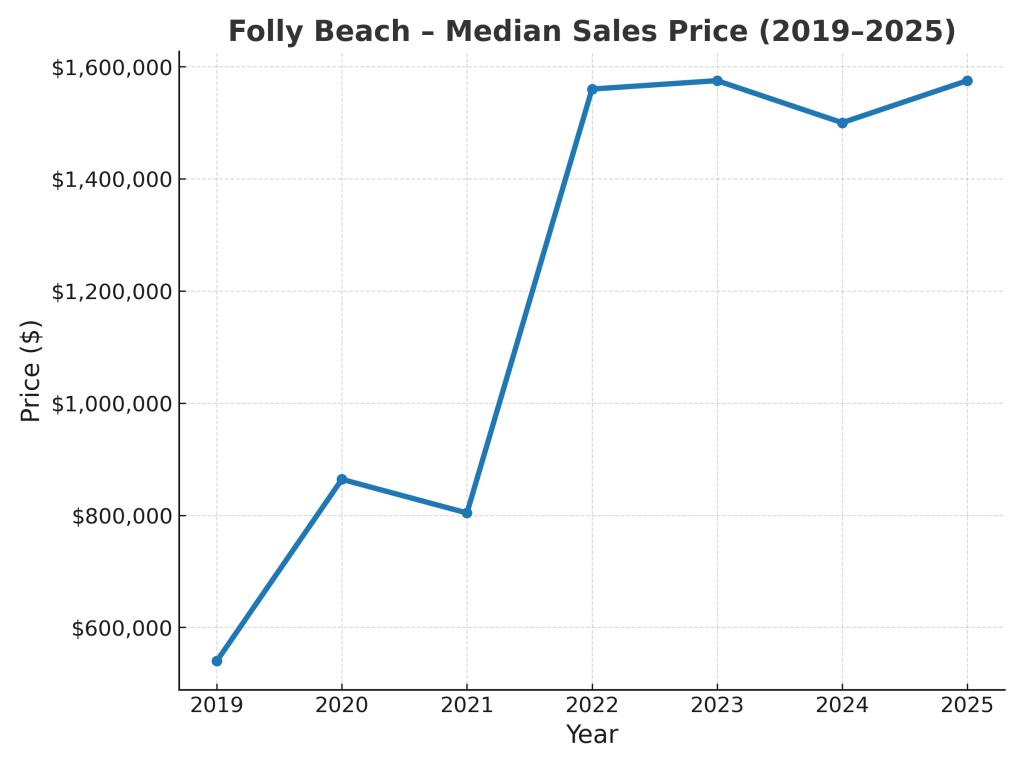
- Median values are up nearly 105.3% since 2019.
- Longer Days on Market shows balance, not collapse.
- Average price remains steady at record highs around $1.5M+.
- Our community character drives value for residents and visitors. The STR Cap protects livability and ensures demand is rooted in the community, not speculation.
Since 2019, median home values on Folly have more than doubled, rising from just over $657,617 to $1.35 million in 2025. Average sales prices continue to hold above $1.5 million. Those numbers show resilience, not collapse.
During the pandemic surge, homes sold in less than three weeks. Today, they take closer to 114 days. That shift isn’t a weakness; it’s a return to balance, where buyers have time and sellers still achieve premium values.
As your Mayor, I will continue to defend the integrity of the STR Cap, because keeping Folly livable for residents is what sustains both our neighborhoods and our property values. Looking ahead, I’ll also lead on the challenges that matter most — protecting our beaches, managing flooding, and strengthening infrastructure — so Folly stays resilient for generations to come.
A-Tax Bottom Line
The argument that A-tax revenue will decline at the 800-license cap overlooks how tourism economics actually work. The STR Cap protects the balance that makes Folly attractive to visitors in the first place. More rentals don’t automatically mean more revenue; in fact, they can dilute demand. By maintaining the cap, we protect both our community and the sustainable revenue that supports City services.
- Occupancy, not just unit count, drives revenue. Folly’s A-tax is generated by actual rental nights booked, not the theoretical maximum number of licenses. With high occupancy rates in existing rentals, revenue can remain strong even without adding more licenses.
- Fewer, higher-performing units often outperform unchecked growth. Market studies show that adding too many rentals in a small market like Folly can actually cannibalize occupancy, driving down average daily rates and reducing revenue per property. A capped market supports stability and higher performance for existing operators, which sustains A-tax revenue.
- Quality of demand > quantity of units. Visitors don’t come to Folly for sheer rental inventory — they come because Folly offers a safe, vibrant, and authentic community experience. Protecting community character ensures Folly remains a desirable destination, keeping A-tax revenue healthy.
- Sustainable growth protects long-term revenue. If livability declines due to over-saturation of rentals, residents suffer, and visitors take note. That can erode Folly’s reputation, which would do far more long-term harm to A-tax collections than holding steady at 800 licenses.
- The record shows resilience. A-tax and Hospitality-Tax collections have remained strong year after year. Evidence that visitors are still coming, dining, and staying.